Category: News

  • Club Tuseme fights against poor eating habits in Musaza sector

    Kirehe District based Club namely “Tuseme club” has fought against poor eating habits in Gasarambwayi cell in Musaza sector through kitchen gardens for the residents and making people understand the importance of these gardens.

    Vincent de Paul the executive secretary of Gasarambwayi cell said that now people understand the importance of the garden kitchen and thanks to Tuseme club which sensitized people about them and built for those who didn’t have them.

    He went on to say that with the help of health advisors, Tuseme club taught people on how to make a nutritious meal in a way of fighting poor eating habits in this cell.

    Vincent de Paul said that there were about 23 children who were suffering from malnutrition but because of Tuseme club and health advisors who taught people on how to prepare well a meal, these children are well and there is no more malnutrition in this cell.

    He said that they have goats which are milked for these children so as to feed them well. The district gave financial support to Tuseme club with Rwf500, 000 so as to continue fighting against poor eating habits in Musaza sector.

  • Bharti Airtel builds environmentally friendly mobile network

    An Indian Telecommunication company (Bharti Airtel) has announced significant milestones in its endeavour to build a ‘green’ environment friendly mobile network (wind power) intending to reduce its carbon footprint in Africa.

    As part of its commitment to the environment, the company has undertaken a series of initiatives that are starting to deliver tangible results in conserving environment while developing technology in communications.

    The Company revealed that over last one year, it has reduced the number of telecom sites running solely on diesel by more than 50 percent by overcoming the challenge of lack of grid connectivity through use of innovative models such as Hybrid Battery Bank.

    By 2013, the Company aims to completely eradicate the constant use of diesel to power its network. This means no telecom site of the company will rely solely on diesel power 24 hours a day.

    Hybrid Battery Banks collect the excess energy produced by the diesel powered generator in a battery that powers the site once the generator is switched off. This has helped reduce the use of diesel by up to 14 hours a day. Close to 60percent of Bharti Airtel’s telecom sites in Africa are now powered using the Hybrid model resulting in major reduction in emissions and also operating costs for the company.

    The Company is targeting over 70percent of all its sites to be powered by the Hybrid model by end of 2013. It added that, the work is targeting on increasing the use of solar and wind power to power its telecom sites.

  • Kagame is an Advocate of Social Media Use for Efficient Governance

    Whereas most people in their over 40 years of age have often found difficulty coping with Internet’s social media,Rwandan President Paul Kagame has gone beyond utilizing them to encouraging his team in utilizing the media for efficient governance.

    “In the case of Rwanda, we have instituted policies where our citizens can utilize social media to access their leaders.” President Kagame said at the Broadband Commission’s Youth forum in Kigali late last year 2011.

    If you have always wished to express your views to the president of the republic of Rwanda and you have never had the chance to, then through his actual Facebook and Twitter accounts, you should be rest assured that your message will get to him.

    Some of the beneficiaries of such head of state’s presence on facebook and twitter includes Rwandan university students who posed their monthly stipend questions and received answers through it, not to mention Arsenal football fans’ clarifications from the President’s Twitter account about the Sun’s article titled “Rwanda Leader: Wenger must go”.

    Subsequently we have seen each district of Rwanda create a webpage with links to the social media not to mention the minister of health Dr. Agnes Binagwaho’s “Monday’s with the minister on twitter”.

  • Rwanda to offer Hollywood like Multimedia Lessons

    Glittering Macintosh desktops, Nikon cameras and many other electronic systems are some of the materials you will see at Kigali’s new multimedia institution called Africa Digital Multimedia Academy (ADMA) located in Kigali town.

    According to Christopher Marler, ADMA’s Project Manager, he says that “Given a planning period of about 2 years, the government of Rwanda in partnership with multimedia Experts from USA, they have managed to gather high quality equipment necessary to provide products of the Hollywood standard.”

    Marler who is a senior vice president of a California based multimedia company named PixelCorps, says that ADMA is to offer as far as five different levels of multimedia professional courses.
    “We have an intake of 20 students who are on level 1 given the fact they are people who have been exercising a profession in the multimedia industry.” Explains the Multimedia Expert Marler
    “Rwanda government has for the past years invested in development of ICT as evidenced by fibre optic cables inter-linking all Rwandan districts, thus given the ICT infrastructure and ADMA’s experts, this school guarantees high quality multimedia skills” said the Director General of Workforce Development Authority WDA Gasana Jerome.

    The school is expected to begin offering studies on 5th March 2012, with 20 students enrolled who will later be joined by another bunch of 30students continuously every 3 months till a total of 100 students is reached required academic year.

  • No Strings attached to CMU-R Scholarships, says Kayonga William

    No Strings attached to CMU-R Scholarships, says Kayonga William

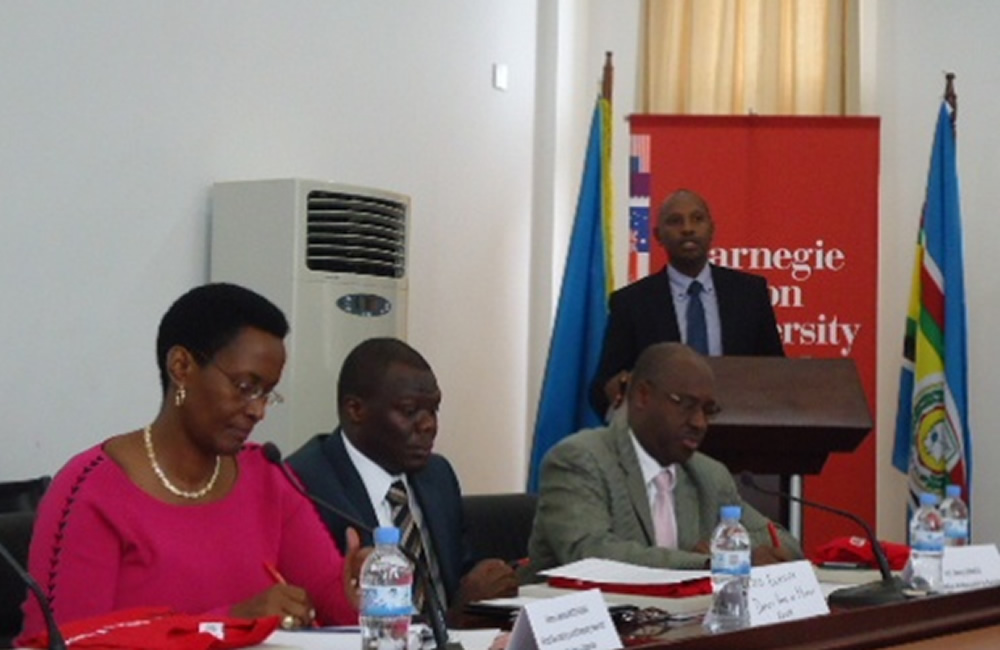
    The morning of 02 March 2012 brought good news to East Africans who are technology savvy as the government of Rwanda officially announced its offer of a 50% scholarship for tuition fees to all EAC students eligible of studying at Carnegie Mellon University- Rwanda.

    Following this program’s unusualness as regards most of African settings’ systems, skeptics questioned how an African government like Rwanda’s would be willing to offer 50% scholarship without attached strings (like signing side contracts with beneficiaries of the scholarships to work in Rwanda for a number of years before being free) .

    “There are no strings are attached, the government of Rwanda will only sponsor the 50% tuition fee whereas Carnegie Mellon University-Rwanda will handle admission, registration, graduation and all the other processes as their Pittsburg main campus does.” Said the Permanent Secretary of Ministry of East African Community, Ambassador William Kayonga at a press conference.

    Professor Bruce Krogh, Director of Carnegie Mellon University in Rwanda assured that CMU-R is to offer a learning environment and academic qualifications similar to those offered by the CMU main campus in Pittsburg.

    “We are convinced that the technological breakthroughs that are going to be the foundations of the ICT industry in Africa will come from inventors and entrepreneurs who work in Africa and understand the technological challenges and needs that are unique to Africa.” Said Professor Krogh

    Government of Rwanda continues to heavily invest in education especially in the ICT sector as evidenced by the current scholarships of master’s in communication at KIST and Hollywood like Multimedia Lessons at Africa Digital Multimedia Academy.

  • Kitoko Performs at Ange Kagame’s Birthday Party

    Renowned Rwandan Afro-beat singer Kitoko, performed at Ange Kagame’s birthday party. The party, which was held as a private event, had an elite guest list, comprising of the who’s who in Rwanda.Kitoko’s performance was the highlight of the event. The singer stole the show with him crooning many of his  hit numbers, including his popular ‘You’. The audience were enthralled by his performance.The crooner who shot to fame with his recent performances, is also billed to steal the show at the Rwanda Day 2011.

  • East African Ministers Slow Tourist Visa

    East African Community (EAC) ministers in charge of immigration are yet to meet to consider a proposal for a common tourist visa-a proposal, which if adopted, would bring to the fore benefits of marketing East Africa as a single travel package.

    Kenya, Uganda, Tanzania and Rwanda’s state-run tourism agencies already market East Africa at international fairs as a single destination but failure by immigration bosses to make progress on the adoption of the proposal, has failed an unprecedented move that would boost revenues and tourist numbers.
    A Uganda immigration official told an East African consultative meeting on facilitation of air transport last week in Uganda’s eastern town of Jinja.  No progress has been made in Tanzania as the immigration bosses there are yet to meet to even consider the proposal.

    The proposal was mooted by the Kenya Tourist Board (KTB) more than three years ago. In Kenya,  the situation is the same as is the case in Tanzania, but there are plans to introduce visa stickers.

    The EAC Council of Ministers, which is the designated decision-making authority on all matters that touch on the sovereignty, revenue, policy and immigration matters, is the organ that will ultimately adopt the joint visas for tourists.

    A single tourist visa would allow tourists to travel through a series of endless borders to sample the unique attractions that East Africa has to offer.

    The EAC Secretariat has listed the single tourist visa among its foremost future plans and had initially hoped that it would have been agreed upon by the five states, Burundi, Kenya, Rwanda, Uganda and Tanzania by November 2006.

    Tourists continue to demand to sample the entire array of tourist attractions spread across the region, from Mombasa’s breathtaking beaches, Tanzania’s Ngorogoro Crater, the chimpanzee parks in Tanzania, Uganda and Rwanda’s mountain gorillas and other wildlife safaris. While the technocrats are still considering the proposal, their reluctance to agree on a joint visa for tourists, has, however not crippled the joint promotional activity.

    The strategy has been applied during international tourism exhibitions where tents of all the five member states have been placed close to each other. According to the plan, a tourist would apply for a visa in any one of the five states and would travel uninterupted to all the countries.

    Tourist boards from Kenya, Uganda and Tanzania are the joint inventors of the plan, a crosscutting measure, which aims to standardise all tourism facilities in the region, including hotels and other tourism facilities.

    Tanzania’s Tourist Board (TTB) favours a system where member countries market their tourist attractions independently with a joint banner bearing common features designed by the EAC Secretariat on the background of the booths. These initiatives are aimed at ensuring decisions made by the Council of Ministers on promotion and cooperation in tourism are implemented. Tanzania is Kenya’s most serious competitor as a destination for foreign tourists after the US followed by the UK and South Africa.

    Uganda also ranks among the top 10 destinations in the world with a 6.2% preference level compared with the 21.7% who prefer to travel to  Tanzania is closer at 17.5%. These rankings are a powerful indicator that the East Africa region has potential to become one of the world’s biggest global  attractions as a single package rather than a disjointed bloc. Uganda Gorilla safaris are a key attraction for vistors to Uganda, while masai mara is a key attraction for Kenya safaris, while kilimanjaro is a key attraction for Tanzania

  • Haunted by the Rwanda Genocide: Girl Abandoned in Uganda

    Kampala:
    Orphaned at the age of 5, she lives with adopted parents, one of whom was this year killed by the same people who killed her parents. Now living as a ‘refugee’ after being abandoned in Uganda, Grace Anny Uwera cannot help regretting why she was born.

    Uwera, who comes from the Rwandan District of Gisenyi, lost both her parents and all relatives during the 1994 Rwanda Genocide-a common story for many Rwandan children.

    Uwimana Chautae, who adopted her in 1998, abandoned her recently at Entebbe Airport. Given only Ushs 3,000 (US$1.5) to bring her to Kampala, Uwera was ‘condemned’ to the streets of Kampala where she had to find a new home, food, relatives and all.

    “She told me that when she reaches London, she will call the refugee camp and direct them to send me to London. Up to now, I don’t know where the refugee camp is,” Uwera says.

    Now aged 16, Uwera was recently ‘saved’ by a Muzungu lady, only identified as Sarah, who took her to Candlelight Foundation, an NGO based in Mengo, Kampala. The NGO collects disadvantaged girls from the streets. Even with some care here, hope is still distant for Uwera.

    After many days of negotiation, Uwera has finally agreed to talk to us. Uncontrollable tears roll down her chubby cheeks as she narrates her ordeal. Even when she is beckoned by her new friends at Candlelight to “be strong”, tears continue to come as she narrates the unforgettable night the soldiers came to their house and killed her family members using machetes during Rwanda’s historic turmoil in 1994.

    “The Hutu soldiers butchered my father and mother, together with two of my elder sisters. I was left alone,” Uwera says with much effort.

    The 11 years that have passed have not made Uwera forget anything of the gruesome murders. “My father was a Senegalese while my mother was a Rwandese (Tutsi). My father became a Rwandese national after marrying my mother. I still remember them and miss their love and attention. My father’s name was Niwemugabo Ally Djuma and my mother’s, Bankundiye Amina,” she recalls.

    That is when she looses her temporary smile. She says the memory of her parents makes her envious of children who have ‘the luxury’ of their parent’s love and care. Even when they were still alive, Uwera never had the opportunity to experience their full attention.

    “My father was a driver of a petroleum truck that used to transport fuel from Mombasa to Rwanda and was rarely at home. My mother was a nurse and she operated her own clinic,” she reminisces. That was years ago, and she has accepted her fate.

    Uwera says that knowing about her Senegalese origin and relatives is something that would make her life different; since it is the only way she could get the love of a relative.

    “My family perished before my father could take me to Senegal. He used to say that my grandparents are in Senegal and I always dreamt of going there,” she says.

    Uwera takes Uwimana, with whom she had lived for the last five years, to be a good parent, although she abandoned her. She believes this happened because Uwimana failed to get necessary documents for Uwera and her two kids to travel to Britain.

    Uwera says that Uwimana was escaping from Rwanda because she realised that her life was in danger after opposition politicians killed her husband in May this year.

    “It was being said they were looking for Uwimana to kill her too. I would go back to Rwanda, but it’s impossible because every body knew that I was a daughter to those people. They can kill me as well,” says the teenager. Our attempts to confirm this allegation from Rwandan Authorities were fruitless.

    Uwera who says she left Rwanda while in secondary school wants to go back to school and sees school “as the only way for my future.”

    Rosette Nabuuma, the Manager Candlelight Foundation says the Organisation is considering taking Uwera back to school like the rest of the girls they get from the streets. “But we need continuous assistance in order to appropriately cater for these disadvantaged girls and make their lives better,” Nabuuma says.

    Uwera, like the rest of the girls, has been taught how to make candles so that she can earn some little living. Not much hope for Uwera though! Because for every day that passes, her hopes of going back to school and finding her relatives in Senegal-the two things she loves most in the world, become more and more slim.
  • Uganda Now the Fraud Capital of Africa

    Beating Nigeria in crime statistics is no easy feat. Monitored by international law enforcement agencies from Scotland Yard to the FBI and blacklisted by immigration authorities from Tacoma, Washington to Taipei, Nigerian crime networks reach far. Every year, the private and public sectors of the West African nation lose $40 billion (U.S.) to corruption. And every day the oil-rich nation loses 100,000 barrels of crude to thieves, many of them government employees.

    Now, Uganda, once hailed as the model emerging economy in Africa and one of the standards for financial transparency on the continent, is racked by a growing scandal: check fraud. Whether the spike in financial crime is a sign of a population increasingly seduced by material wealth, or if it is a reflection of a desperate public striving to get along by whatever means it can, the statistics make for bad public relations. For a nation dedicating a sizeable share of its resources to attracting international investment, the news of fraud is even more threatening. Hung in the balance between steady economic growth and what many suspect may be a creeping downturn, Uganda is a nation of many faces. The rising fraud is one of its ugliest.

    Fraud has nothing to do with the country or ethnicity. It is the individuals who defraud banks and international businesses. Of recent, Uganda has recorded more fraud attempts than Nigeria in sub-Saharan Africa, said Johan Hartman, Citigroup fraud manager for Europe, Middle East and Africa. Speaking last week at a seminar on fraud management at the Grand Imperial Hotel in Kampala, Hartman said his firm, working with others, is organizing to stamp out the growing theft problem.

    Local authorities have also adapted a more aggressive stance to the corruption. Justine Bagyenda, a director at the Bank of Uganda, said committees have been formed to study the nature of the schemes and identify its perpetrators. She also instructed banks and other financial institutions to be vigilant in checking the backgrounds of people they hire. Some people have bad track records,” she warned.

    Meanwhile on the streets of Kampala, a loose network of criminals, savvy on the Internet, familiar with international financial networks, aligned with Ugandans abroad, and plugged into financial industry insiders, are forging checks and enjoying the spoils. The criminals illegally pull money from bank accounts in Europe and the United States by using routing numbers and dummy checks. They also write bad checks for trophy automobiles, electronics and other goods in Asia.

    United Nations groups have also stepped up their investigation of the scandals, not only in Uganda but also in a broader region of countries that include South Africa and Botswana. But the informality of the criminal networks makes spotting the schemes difficult. And the criminals take advantage of an unsophisticated law enforcement infrastructure unaccustomed to fighting white collar crime.

    Also, increasingly becoming a hub of international money laundering, Uganda faces pressure from the international community to play an active role in stemming the corruption at home. Right now, a law against money laundering is making its way through the Ugandan legislature. The government response has been positive and swift but what impact the laws will have on the disorderly and erratic nature of the scams, has yet to be seen.

    In a globalizing Africa where the public access to technology is outpacing the governmental cyber-defense mechanisms in place to regulate it, expect to see these problems grow — and spread. It will require broad-based international cooperation, both private and governmental, to tackle and hold down this growing wave of crime. How this will affect the continents individual economies has yet to be calculated.