Blog

  • The 5 Types of Cyber-Attack you’re most likely to Face

    One of the biggest security problems is perception: The threats companies think they face are often vastly different than the threats that pose the greatest risk. For example, they hire consultants to deploy state-of-the-art public key infrastructure (PKI) or an enterprise-wide intrusion detection system when really what they need is better patching.

    The fact is most companies face the same threats — and should be doing their utmost to counteract those risks. Here are the five most common (and successful) types of cyber attack.

    1. Socially engineered malware

    Socially engineered malware, lately often led by data-encrypting ransomware, provides the No. 1 method of attack. An end-user is somehow tricked into running a Trojan horse program, often from a website they trust and visit often. The otherwise innocent website is temporarily compromised to deliver malware instead of the normal website coding.

    The maligned website tells the user to install some new piece of software in order to access the website, run fake antivirus software, or run some other “critical” piece of software that is unnecessary and malicious. The user is often instructed to click past any security warnings emanating from their browser or operating system and to disable any pesky defenses that might get in the way.

    Sometimes the Trojan program pretends to do something legitimate and other times it fades away into the background to start doing its rogue actions. Socially engineered malware programs are responsible for hundreds of millions of successful hacks each year. Against those numbers, all other hacking types are just noise.

    Countermeasure: Social engineered malware programs are best handled through ongoing end-user education that covers today’s threats (such as trusted websites prompting users to run surprise software). Enterprises can further protect themselves by not allowing users to surf the web or answer email using elevated credentials. An up-to-date anti-malware program is a necessary evil, but strong end-user education provides better bang for the buck.

    1. Password phishing attacks

    Coming a close second are password phishing attacks. Approximately 60 to 70 percent of email is spam, and much of that is phishing attacks looking to trick users out of their logon credentials. Fortunately, anti-spam vendors and services have made great strides, so most of us have reasonably clean inboxes. Think of an effective phishing email as a corrupted work of art: Everything looks great; it even warns the reader not to fall for fraudulent emails. The only thing that gives it away is the rogue link asking for confidential information.

    Countermeasure: The primary countermeasure to password phishing attacks is to have logons that can’t be given away. This means two-factor authentication (2FA), smartcards, biometrics and other out-of-the-band (e.g., phone call or SMS message) authentication methods. If you can enable something other than simple logon name/password combinations for your logons, and require only the stronger methods, then you’ve beat the password-phishing game.

    1. Unpatched software

    Coming in close behind socially engineered malware and phishing is software with (available but) unpatched vulnerabilities. The most common unpatched and exploited programs are browser add-in programs like Adobe Reader and other programs people often use to make surfing the web easier.

    Countermeasure: Stop what you’re doing right now and make sure your patching is perfect. If you can’t, make sure it’s perfect around the most exploited products, whatever they happen to be in a given time period. Everyone knows that better patching is a great way to decrease risk. Become one of the few organizations that actually does it. Better yet, make sure that you’re 100 percent patched on the programs most likely to be exploited versus trying unsuccessfully to be fully patched on all software programs.

    1. Social media threats

    Our online world is a social world led by Facebook, Twitter, LinkedIn or their country-popular counterparts. Social media threats usually arrive as a rogue friend or application install request. If you’re unlucky enough to accept the request, you’re often giving up way more access to your social media account than you bargained for. Corporate hackers love exploiting corporate social media accounts for the embarrassment factor to glean passwords that might be shared between the social media site and the corporate network. Many of today’s worst hacks started out as simple social media hacking. Don’t underestimate the potential.

    Countermeasure: End-user education about social media threats is a must. Also make sure that your users know not to share their corporate passwords with any other foreign website. Lastly, make sure all social media users know how to report a hijacked social media account, on their own behalf, or someone else’s. Sometimes it is their friends who notice something is amiss first.

    1. Advanced persistent threats

    There is one major corporation that has not suffered a major compromise due to an advanced persistent threat (APT) stealing intellectual property. APTs usually gain a foothold using socially engineered Trojans or phishing attacks.

    A very popular method is for APT attackers to send a specific phishing campaign — known as spearphishing

    Countermeasure: Detecting and preventing an APT can be difficult, especially in the face of a determined adversary. All the previous advice applies, but you must also learn to understand the legitimate network traffic patterns in your network and alert on unexpected flows. An APT doesn’t understand which computers normally talk to which other computers, but you do. Take the time now to start tracking your network flows and get a good handle of what traffic should going from where to where. An APT will mess up and attempt to copy large amounts of data from a server to some other computer where that server does not normally communicate. When they do, you can catch them.

    Other popular attack types such as SQL injection, cross-site scripting, pass-the-hash and password guessing

    Lastly, avail yourself of a product or service that specializes in detecting APT-style attacks.

  • 5 Tips for Success as a Business Woman

    5 Tips for Success as a Business Woman

    Some characteristics of successful women in business are natural, but some require hard work and dedication in order to learn fully. In order to become a truly successful business leader it is important to keep in mind that achieving success is not going to be easy but in the end it will be worth it. Here are some of the steps that say business leaders say you should follow in order to be successful.

    1. Focus on your passion

    It is always important to remember that in order to be successful you have to love what you are doing. Find a way to turn your passion into a useful tool that can help your work stand out and set you apart from others in your field. If you admire someone in your field reach out to them and see if they can help you learn the ropes. Learn how their passion has progressed their career and see how it can progress yours as well.

    2. Make a plan and prepare

    It is always a good idea to write down your goals in order to make yourself more accountable for them. Once you write them down, come up with steps that you are going to take in order to achieve them. Of course your plans may change but it is important to have a starting point so that you can visualize the path that you are going to take. Make sure to set both short and long -term goals. A goal such as attending a network event can seem simple and short but it will set you up for success when reaching some of your long-term goals.

    3. Be patient

    You need to understand that you don’t start at the top; you have to work your way there. Approach each job and task you have as a learning opportunity and make sure you get the most out of it. Understand that things take time and take that time to learn and grow so when your time comes you are fully prepared to be successful.

    4. Take a risk

    Be bold, take some risks that you might not normally take. If you know what you want, take the leap and follow your passion. If you are stuck in a dead-end job and are not following what you truly want to do, find a new job. Being successful means you will have to make some hard choices and make some bold moves in order to really set yourself apart. The risk is normally worth the reward.

    5. Preserve

    Surround yourself with a group of positive people with positive thoughts. Things are not always going to be easy but try taking different approaches when it comes to success. Of course with anything you are going to run into failure, but you need to stick with it and understand that the successes are going to be worth it.

  • Rwanda Parliament Passes Draft Constitution Amendment

    The Rwandan parliament has unanimously passed the first draft amendment constitutional with a 71 members of parliament giving a go ahead, and only five votes remained withheld and nullified.

    The vote was made after a detailed debate and questioning on some of the articles, especially article 101 where parliament demanded that the commission clearly states what citizens demanded for when petitioning parliament for the amendment process.

    Over three million Rwandans petitioned parliament over the constitution amendment on article 101, asking that the

    Presenting to the low house of deputies, the commission’s vice chairperson, Usta Kayitesi said that all articles including article 101 have been revised and will have to go through referendum based on the popular voice of Rwandans.

    She also said that views of amending article 101 were prominent and the removal of term limits was highly considered in amending the constitution giving the president (Paul Kagame) another seven years and an open ended term limit afterwards.

    She also stated that the process of amending other articles was vigorous and considering time spent, the committee had to deal with various issues such as the need to correct some articles, terminology and eliminate outdated phrases, example on the establishment of Gacaca courts.

    “If we get a go ahead on this first draft, there is more that will be changed but the issue we kept clear was not to have many irrelevant articles which can be supported by the laws, but we didn’t create any juridical gaps in amending the constitution.” Kayitesi said.

    The voted bill will be submitted to the senate. Once the senate approves it as is, a referendum will be held without fail.

    The senate is not likely to overturn the massively voted bill, considering the fact even the Supreme Court last week ruled in fovour of the amendment in a controversial court case by the Democratic Green Party of Rwanda that sued against the amendment.

    Both the date for the senate’s approval and the consequential referendum were not discussed.

  • Kagame, Kenyatta Endorse New AfDB Energy Deal

    President Paul Kagame and his Kenyan counterpart Uhuru Kenyatta have endorsed the ‘New Deal on Energy’, a vehicle through which the African Development Bank (AfDB) will invest in delivering electricity for all Africans, by 2025.

    Both Kagame and Kenyatta were speaking on a live CNBC-Africa television debate that also featured AfDB president Dr Akinwumi Adesina, yesterday afternoon, on the sidelines of the 51st AfDB Annual Meeting ongoing in Lusaka, Zambia.

    Speaking to a fully packed audience, the three leaders shared their ideas on the ‘path to universal access to energy in Africa by 2025’, which is what the AfDB’s new deal on energy intends to achieve under President Adesina’s leadership.

    “This new deal on energy is a big deal for Africa,” said President Kagame adding that it brings a new momentum in the efforts of doing what Africa should otherwise have done, long time ago.

    Kenya President Uhuru Kenyatta also backed the ‘new deal’, noting that Africa has a lot of potential in renewable energy sources that just needs further enhancement.

    “We have heard and had enough of the theory. It is now time for practical engagement by supporting the AfDB to leverage Africa’s huge potential,” said President Kenyatta.

    In his remarks, Adesina noted that Kagame and Kenyatta represent what Africa needs most at the moment, the political will to translate Africa’s potential into tangible benefits for its people.

    “Money is not the key. Political will is all we need to get things done,” said Adesina.

    Dr Adesina noted that although it is true that Africa has a lot of energy potential, industries don’t run on potential, they run on energy.

    The AfDB has pledged to commit $12 billion over the next five years to invest in energy alone and ensure there is access to electricity for all Africans by 2025.

    Currently, only about 16 per cent of Africans are said to be connected to some sort of energy source, with another over 645 million Africans having no form of access to electricity, while over 700 million persons don’t have access to clean energy for cooking.

    The goals include expanding grid-power by 160 Giggawatts, connecting 130 million people to grid, another 75 million people connected to off-grid sources and 150 million households to clean cooking energy.

    The 51st AfDB Annual Meetings are being held under the theme, “Energy and climate change,” and this, according to Adesina, is for a good reason, because by solving Africa’s electricity challenge, natural resources, such as forests, will be saved.

    President Kagame backed Dr Adesina’s thoughts on electricity noting that, on top of being tired of darkness, Africa is also tired of poverty which can be addressed through industrialization and creation of jobs for the youth .

    “There is pressure from our people and there is commitment among the leaders to deliver but we must find ways of accelerating our progress to deliver results faster,” said President Kagame.

    According to President Kenyatta, investing in inter-connectivity of countries is among the areas that need to see more efforts from African leaders.

    “We must look at energy as any other commodity that we can trade among ourselves. We must invest in connectivity to enable those that have more of electricity resources to share with those that have less of it,” he said.

    President Kagame cited an example where a deal between Rwanda and Kenya to export 30 megawatts to the former has been rendered impossible because of lack of a transmission line between the two countries; this he noted, was a key area for investment.

    All three leaders concurred on the need to involve the private sector into investing in energy and noted that countries should begin by advancing reforms in their respective energy generation and distribution sectors to open up space for new players.

    Heads of State and Government at the summit also included Presidents Edgar Lungu of Zambia and Idriss Deby of Chad. Nigerian Vice-President Yemi Osinbajo, Prime Ministers of Tanzania and Mozambique – Kassim Majaliwa and Carlos Agostinho do Rosário, respectively, were also in attendance.

    Other high-profile attendees include singer Akon, Kofi Annan, Aliko Dangote, Ashish Thakkar, John Kufuor, Mary Robinson, Mo Ibrahim, Nancy Lee, Ngozi Okonjo-Iweala and Tony Elumelu, among others.

  • Rwanda’s Energy Sector Gets $202bn from EU

    In East Africa, the European Union (EU) has engaged in a funding agreement with Rwanda that is worth €177 million ($202 billion), which will be directed towards the energy sector over the next five years.

    The financing pact is the first of a series to be signed in the coming months as part of a €460 million ($52.5 billion) programme of EU grant financial assistance to Rwanda agreed in 2015, reports The New Times.

    The minister of finance and economic planning, Claver Gatete, said the funds will help Rwanda to improve the supply, transmission and distribution of electricity as well as assist the country reach its goal of becoming a middle income country by 2020.

    “Energy is one of the top priorities for the government of Rwanda and access to modern energy for a major part of the Rwandan population and the development of its productive activities is a prerequisite for the achievement of our development goal of becoming [a] middle income country by 2020,” Gatete said.
    EU asserts commitment

    Speaking on the development, Michael Ryan, the head of the EU delegation to Rwanda stated that the assistance will continue to focus on strategic areas, including energy, agriculture, and good governance.

    Ryan echoed the finance minister’s views stating that the funding will translate into increased productivity, poverty reduction and help propel the country towards becoming a middle income economy, adding that the EU’s commitment to Rwanda’s long term prosperity and stability is unshakeable.

    “This €177 million grant for energy will help improve access to energy, particularly for those in rural areas. 2016 is an important year for the EU in Rwanda.

    “We will be signing several more such financing agreements, including a €200 million grant to agriculture – this will be our largest single financial operation in Rwanda to date,” he said.

    Rwanda’s current installed power generation capacity is reported to be standing at 186MW, against a target of 563MW in the next two years.

    According to the media, the minister for energy, water and sanitation, Germaine Kamayirese, has stated that the government has designed a new energy policy seeking to boost transmission, reliability and affordability of power across the country.

  • Rwanda: Ruzizi III hydropower obtains more funds

    Rwanda has signed a $24.17 million financing agreement with the African Development Bank (AfDB) in support of the regional 147MW Ruzizi III hydropower plant (HPP).

    Rwanda’s minister for finance and economic planning, Claver Gatete, commented: “The project [Ruzizi III hydropower] underscores the importance of ensuring reliable and affordable electric power supply to achieve sustainable economic transformation.”

    Gatete noted that the concessional loan is one of the cheapest as it stands at 0.75% and will be paid back in 38 years with a grace period of five years, reports The New Times.

    The Ruzizi III plant is a regional project shared by Rwanda, Burundi, and the Democratic Republic of Congo (DRC) and is expected to generate more than 147MW of electricity.

    The generated power will be shared equally amongst the three participating countries with Rwanda getting at least 50MW of electricity.

    Gatete also stated that the hydropower project is the first regional project designed as a public-private partnership aimed at optimising the hydropower potential across the region.

    According to the media, the entire Ruzizi III hydropower project is estimated to cost $625 million, including the AfDB’s overall contribution of $190 million covering contributions for Burundi, DRC and Rwanda, and resources to be lent directly to the Project Company on commercial terms.
    Ruzizi III relevant to climate change

    The AfDB country representative, Negatu Makonnen, disclosed that the project package will also include an 8.3 kilometer and 220kV transmission line connecting Kyamanyola power dispatch centre and associated power evacuating lines.

    Makonnen said: “Sustainable regional infrastructure is a necessity for strong regional integration and key to successfully tackling today’s most challenging climate change-related problems and security.

    “The Multinational Ruzizi III HPP is central to AfDB’s strategic vision for the development of the African energy sector through the promotion of universal access to low-carbon and inclusive modern energy. This concept has been demonstrated several times in this country.”

    Construction of the project is expected to commence in 2018 and could take four year to reach completion.

  • PV project at Rwanda genocide site begins operation

    A memorial to the 1994 genocide in Rwanda is to be powered almost entirely from solar following the completion of a PV system on the site.

    The project was completed earlier this month at the Genocide Memorial in the Rwandan capital, Kigali.

    Details of the project’s size have been withheld for customer confidentiality reasons, but David John Frenkil, founder and managing director of Centennial Generating Co, the company behind the project, said the system would meet the majority of the memorial site’s electricity needs.

    “The project will reduce most of the need for power during sunlight hours. The memorial centre is the most visited tourist site in the country and it’s quite large in terms of its energy demands, so it’s pretty great to remove most of the power needs and we sell them the power at a rate that’s cheaper than they get from the utility,” Frenkil said.

    Later in the year Frenkil said battery storage units would be added to the solar system to provide additional protection against power outages. Frenkil said the expected storage system would provide two hours of battery back up, safeguarding against most power shortages.

    “Our data shows that roughly 85% of power shortages [in Kigali] are less than two hours. So that means that by providing at least two hours of battery storage we can mitigate most of the need for standby diesel,” Frenkil told PV Tech.

    Centennial is a newly formed company that is targeting principally the commercial and industrial segment in sub-Saharan Africa.

    Frenkil said that with much of the current investment in African solar going to small off-grid systems or large utility arrays, there was a need for investment in projects of an intermediate size that would help businesses cut their power costs and avoid problems associated with unreliable supply.

    “Centennial focuses on a currently under-addressed challenge for commercial and industrial customers in and near urban centres that need more affordable and reliable power supply,” he said.

    Under Centennial’s model, the company finances, installs, owns, operates and maintains the systems it builds. Frenkil said it had a pipeline of PPA in progress with businesses such as hotels, office buildings and factories.

    The second, battery phase of the Genocide Memorial project is due to be completed later this year.

  • Government Says Will Achieve 100% Of Vision 2020 Targets

    President Paul Kagame addressing the audience at the 13th National Leadership Retreat in Gabiro

    The government has announced it will achieve all goals underlined in its Vision 2020 laid 16 years ago.

    Stella Ford Mugabo, the Minister in charge of Cabinet affairs told media that 72% of the national vision 2020 objectives has been attained.

    “We found out that this was the time to discuss what we have achieved, but also look at how to fast track targets that are trialing,” she said while briefing the Media on the resolutions during the just concluded 13th National Leaders Retreat.

    The retreat chaired by President Paul Kagame was held under the theme ‘Striving to promote products made in Rwanda’.

    Minister Mugabo said the retreat discussed four key issues; strategies to fast-track the programs under the vision 2020, the Second Economic Development and Poverty Reduction Strategy-EDPRS 2, and the government’s seven year program ending next year.

    Others included revamping the manufacturing sector in order to increase ‘Made-in-Rwanda’ products, public accountability and ethics as well as guaranteeing rights of children and promoting social welfare.

    EDPRS2, which is expected to close by 2018, has so far scored 76% of the targets while the government’s seven year program ending with the president’s term in 2017 has also scored 75%.

    Uzziel Ndagijimana, State Minister of Finance and Economic Planning said the government is preparing the 2016/2017 fiscal year budget.

    In the budget, the targets that have not been addressed will be catered for. “We agreed during the retreat to put extra effort using the current systems to ensure that we achieve these targets,” Minister Ndagijimana said.

    Targets still lagging behind include; electricity, both generation and accessibility, creation of secondary cities, increasing agriculture productivity, export promotion all of which are key ingredients for the country’s economic growth.

  • 100s and Still Counting, but can Tech Startups Survive in Rwanda

    100s and Still Counting, but can Tech Startups Survive in Rwanda

    Through Mergims app, one can tap on phone to pay for utilities in Rwanda/photo by Roger Rutindukanamurego

    In 2013, Rwanda’s Auditor General released a report indicating that the country had lost Rwf10.5 billion on non-billed water.

    This loss represented 42.38% of the total volume of water produced and distributed in 2013 alone.

    The loss was so high that the auditor general had no better way to describe it. He simply gave it a nick-name: “Inadequate Accountability For Revenue.”

    This gross mismanagement of a national utility, gave two fresh graduates from Tumba College of Technology sleepless nights.

    Two years ago, AlistideNdayisaba 24, a graduate of mathematics and physics told his colleague Imani Bora 21, a graduate in Computer engineering that he had an idea on how to solve the “water billing headache”.

    In a late night talk, while sitting on Ndayisaba’s bed, the two contemplated about an idea of designing an electronic billing system that would put to an end the loss of billions of francs.

    They turned to their computers and embarked on intensive coding after coding for a period of six months. They deprived themselves of sleep.

    Friends and relatives got so exhausted from the nagging boys looking for money to buy chips and microprocessors.

    After eight months of testing, a complete functioning device was showcased to fellow students and family. Everyone was excited.

    However, that is all the two graduates could do. They now need a potential investor or a partner to push their invention to another level.

    Bora told KT Press that they are engaging the Water and Sanitation Corporation Ltd (WASAC).

    Youth brainstorm at Rwanda’s KLab

    Investors Could Risk On Startups

    In October, 2015, Investors at the Transform Africa summit in Kigali were attracted to new innovations showcased by young ICT entrepreneurs.

    Two Rwandan college students; Patrick Umuhire and Umuhoza Cedrick exhibited Vuga Pay, an application that facilitates cross border and cross network Mobile Money Transfer.

    The two innovators were seeking $20,000. They ended up accepting offers from two investors including Tigo telecom which offered to play an advisory role.

    Tigo representative at the summit told the innovators that, “you managed to bypass our system.”

    There are many more others.

    Bora and Ndayisaba’s electronic water billing system is among thousands of up-and-coming innovations in Rwanda. Many are growing fast and generating income.

    MERGIMS, a platform that enables anyone to pay for water, electricity, tuition fees, is spreading across African markets.

    There is SafeMotos app that links passengers to motor taxis. Customers click and get picked up from any location. This app is now expanding to other African countries too.

    Torque Ltd, has a distribution management application. Currently, one of the users of the application is BRALIRWA, Rwanda’s leading beer and beverage factory.

    Another application making rounds helps children with hearing impairment. There is also a-3 D simulated animation program which works as a practical substitute to signs lessons, also intended to hearing impaired children.

    These innovations have attracted investors and it’s a matter of time they roll out to other countries.

    According to Rwanda Private Sector Federation and the Institute of Policy Analysis and Research, startups fail because they lack access to financing. Some of them are not ideal for the market, others lack a business model and owners lack business management skills.

    K-Lab, a government funded open space incubation center for IT entrepreneurs, produces more than 250 projects annually. In 2015, however, only 10 of them attracted funding.

    Pacifique Hallelua, the Manager of k-Lab explains that some startups fail to secure funding because investors don’t trust them with their money. “They don’t trust them, they don’t believe in them.”

    Hallellua explains that there are instances where owners of these startups have to find someone to represent them whenever they have to pitch their business proposals to potential financiers.

    On January 27, K-Lab invited Tony Nsanganira State Minister for Agriculture to interact with young entrepreneurs and inspire them on innovation and the existing opportunities in agriculture sector.

    “Don’t look for a quick kill,” he said. “Successful people don’t expect money right away…it is done through hard work, paying attention to detail and not giving up,” Nsanganira said.

    He advised them to capitalise on networking than doing everything individually. “Keep networking, partner with each other, it is better that way,” he said.

    Some startups say there is another obstacle beyond just networking and partnering.

    Technician on duty

    Banks not convinced by most startups

    Hallellua explains that most startups are on halt due to exorbitant requirements including; high cost of initial capital and collateral to secure funding from banks.

    However, government recently approved $100 million fund to cater for bankable ideas that cannot get financing from commercial banks or capital venturists. Rwanda Development Board will manage the fund.

    Eric Kubwumucunguzi, a member of K-Lab notes there is lack of awareness about such available opportunities.

    “I have been here for more than four years, we have worked on different projects, but none of them has secured funding, from government or private financiers,” Hallellua says.

    And yet, on the other hand, Bora and Ndayisaba with their water billing system for example, have no idea about this fund. “We have a finished product, it works, we tested it, all we need is financial support,” says Bora. “We cannot do anything beyond where we are now.”

    “We are not businessmen,” says Bora. “Our job was to find a solution to a problem, and we have done it. The rest is not our area of expertise.”

    According to banks, a good proposal can easily help startups secure a loan. But most of Rwanda’s young startups do not present proper business plans.

    “Most financial institutions need comfort that a business is profitable considering the high risks involved,” says Frank Abaho, the Public Relations Officer for Development Bank of Rwanda (BRD).

    “BRD used to finance projects in the priority sectors that are above Rwf15million…those below the amount, the bank reaches them through its refinancing product (provides credit lines to SACCOs and MFIs) to reach the small projects,” he says.

    Despite these challenges, some startups, especially those already making revenues, have crashed the walls and forced themselves into the corridors of investors.

    MERGIMS, let’s say, made several pitches and has already received multiple offers. The firm’s CEO, Antoine Muhire says, “It is not easy, but you have to fight hard.”

    “The money is out there, and we will go after it,” he said recently in an interview on The Big Talk show on KT Radio.

  • Tired Of Misery, Genocide Survivors Establish A Billion Francs Fund

    Tired Of Misery, Genocide Survivors Establish A Billion Francs Fund

    A group of students, all members of the association of survivors of genocide against Tutsi (AERG), has established a multimillion fund from which they will mobilise large capital to invest in profitable ventures.

    Any investment they will make, eventually, is expected to draw the orphans out of vulnerable groups.

    AERG members, now 43,000, from Universities, secondary schools and their alumni community, have agreed each to find at least Rwf20, 000 equivalent to one share in the planned Rwf1.3 billion scheme.

    The scheme is named the Youth Initiative for Mutual Support, Investment and Sustainable Development of which a member will own ten shares (worth Rwf200, 000) maximum.

    Since January, members from across the country were approached, and they all bought the idea. They have already begun acquiring the shares through two bank accounts open in Bank of Kigali and Ecobank.

    By August, members will meet again and evaluate the progress and then launch the project in October, 2016.

    “We have two main ideas,” says Jean de Dieu Mirindi, the president of AERG. “We are weighing out between a luxurious nursery, primary and secondary school or a health center in Kigali,” he said.

    “God willing, we will also add on a guest house at the touristic holy land of Kibeho in Southern province,” Mirindi adds.

    The two main ideas take into consideration the general public and the genocide survivors particularly.

    For example, he said, “We are growing up, getting married and we wish to have our children attend to nice schools.” The idea to start a school which would later on, start a university level comes from that vision.

    AERG also thinks that a health center will support genocide survivors who have medical problems.

    In Kigali, they plan to set their venture in Gasabo district, because their previous project, One Dollar Hostel, also from that district, was successful.

    One Dollar Hostel in Kinyinya sector is a complex estimatedat Rwf1.5 billion that hosts over 190 homeless genocide orphans. It was built through contribution of the Rwandan community and is privately managed on behalf of AERG.

    Besides that, they believe Gasabo district is suitable for their dream business.

    Many similar ventures in Rwanda have failed before they break even, largely because of mismanagement. Mirindi says AERG will not let such a thing happen to their project.

    They have set up three managerial structures made of an executive committee, auditing committee and the conflict resolution council.

    He says they draw the experience from other successful investments where they employ 30 permanent staff.

    Currently, they have a planation and also rear 100 beef cattle and 300 goats on a 130 hectares piece of land in Nyagatare district.

    Last season, they grew maize on 27 hectares, and they will soon start harvesting bananas on 5 hectares.

    Apart from business, members have philanthropic activities that support widows and orphans to get shelter, and other social support.

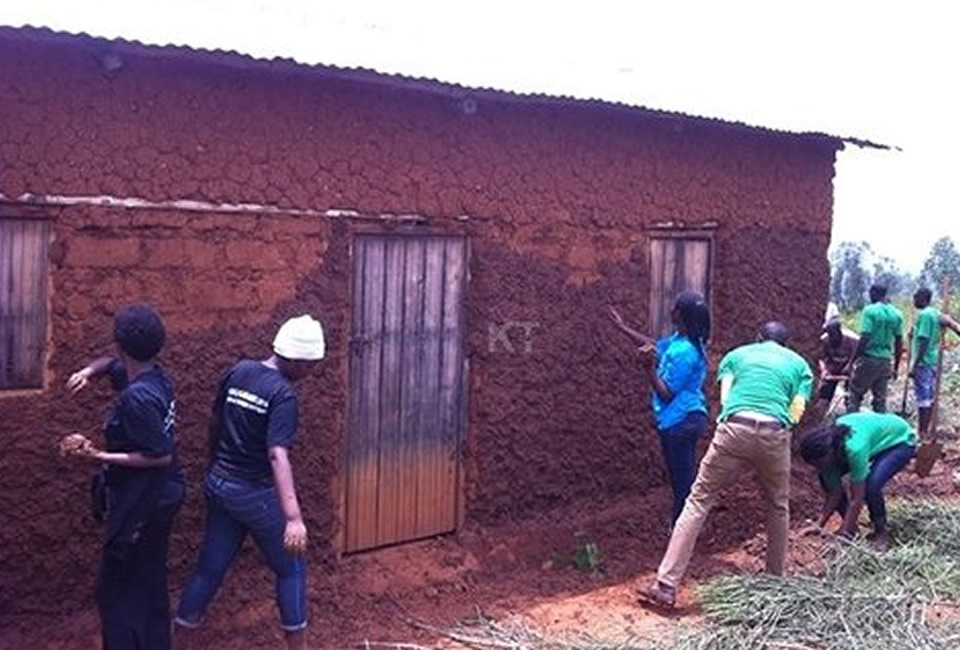
    A week ago, over 300 members headed to Jabana sector in Gasabo district to build a house for an elderly genocide survivor.

    They are also giving one cow to a female retired soldier who fought alongside Rwanda Patriotic Front (RPF) Inkotanyi in the liberation struggle.

    “These activities are very important; trauma cases are declining because we are showing the lonely and needy survivors that someone cares,” says Ruzindana Rugasa, a commissioner in GAERG, the alumni of AERG, which works hand in hand with students to execute projects.